
What You Eat Matters

Updated: Aug 4
Tired of stubborn belly fat?

You can strengthen your core—you cannot crunch away an inconsistent eating pattern. And you don't need perfection! Just consistency, and the right plan!
You can do crunches, you can hold planks.
You can walk, lift weights, attend every class, and work your core. You will likely get stronger (if you're eating enough).
What if you are working out consistently doing crunches and yet,
the weight around your middle is still not changing.
That can be frustrating for sure!
You are doing the work. You are showing up. You can feel yourself getting stronger.
So why isn’t your stomach changing?
Here is the truth:
Your abdominal muscles and the fat surrounding them are not the same thing.
Abdominal exercises can strengthen your core, improve stability, support your spine, and help you move through life with greater confidence. You should definitely be working out your core!
The exercises cannot decide where your body removes fat.
One study found that six weeks of abdominal exercises improved muscular endurance but did not significantly reduce abdominal fat. Exercise still matters tremendously—but your workout cannot do every job.
And sometimes, we expect it to.
We complete the workout and then ignore the remaining hours of the day.
We forget the sweetened coffee, sweet tea, soda,
the handful of snacks.
The drinks over the weekend and the meals that contain very little protein.
Or perhaps we eat almost nothing all day, become exhausted and overwhelmingly hungry, and then wonder why we cannot control our eating at night.
This is not about shame.
It is about telling yourself the truth.
Because you cannot change a pattern you refuse to look at.
YOUR BODY RESPONDS TO THE PATTERN
It's an incredible machine that operates based on the programming you provide.
One salad will not remove abdominal fat.
One dessert will not create it.
One workout will not transform your body.
One missed workout will not destroy your progress.
Your body responds to what you repeatedly do.
It responds to your protocols.
Adapting and evolving based on your daily activities and habits. This concept is rooted in the principle of neuroplasticity, where the brain and body form new connections and strengthen existing ones based on repeated actions and experiences.
Your body responds to your protocols, which are the set routines or guidelines that you establish for yourself. These protocols can include dietary choices, exercise regimens, sleep schedules, and even stress management techniques. If you adhere to a balanced diet rich in nutrients, your body will likely exhibit improved energy levels and better overall health. If however, your protocols involve unhealthy eating habits or a sedentary lifestyle, you will likely experience negative consequences such as fatigue, weight gain, or increased susceptibility to illness. The consistency with which you follow these protocols plays a crucial role in determining the long-term effects on your physical and mental well-being. In essence, the way you choose to live your life, through the actions you take and the routines you establish, directly influences how your body functions and thrives.

Not just on Monday.
Not just when you feel motivated.
Not just during the hour you spend exercising.
Your body is responding to your choices all week long.
Your nutrition, movement, sleep, stress, hydration, alcohol intake, recovery, and daily activity all become part of the message you send.
Ask yourself
What message am I currently sending to my body with my choices, what am I programming my body and mind to do, what protocols am I following?
Ask
“Am I nourishing this body.”
“Am I preserving my muscle.”
“Am I giving myself enough energy to live well.”
Do your choices say,
“I will care for myself when life becomes less busy.”
“I will start again on Monday.”
“I exercised today, so the rest doesn’t matter.”
Do not answer with judgment.
Just answer honestly.
Information gives you somewhere to begin.
It allows you to make choices that program the life you desire.
So how can you actually get rid of the stubborn belly fat?

PROTEIN IS NOT A TREND
If you know me....
I talk about protein often.
Very often.
Some of you may be thinking, “Melissa, we know, Protein!”
I can't nor do I want to change how often I talk about it because protein is not simply for bodybuilders or athletes.
Protein provides amino acids your body uses to maintain and repair muscle and support enzymes, hormones, immune function, recovery, and countless other processes.
As we age, protecting muscle becomes increasingly important.
Muscle supports your:
Strength
Mobility
Balance
Metabolic health
Recovery
Independence
Ability to continue doing the things you enjoy
When you lose weight, the goal should not be to become as light as possible.
The goal is to reduce excess body fat while preserving the valuable tissue that helps you stand, walk, lift, travel, work, play, and fully live your life.
Muscle is precious.
This is why combining adequate protein with resistance training matters—especially during weight loss and as we grow older.
Research suggests many active adults may benefit from approximately 1.2–1.6 grams of protein per kilogram of body weight each day. Individual needs vary based on age, health, activity, body size, and goals.
You do not have to solve the entire protein equation today.
Start with one question:
Where is the protein in this meal?
Not the tiny amount sprinkled somewhere in the background.
A meaningful source.
Tofu, edamame, lentils, beans, peas, soy foods, protein-rich plant milk, eggs, dairy, fish, poultry, lean meat, or an appropriately selected protein shake can all contribute.
You do not need to eat the same thing every day.
But you do need a plan.
PROTEIN MATTERS—NUTRITION IS BIGGER THAN JUST PROTEIN
A protein shake cannot repair an entire day built from highly processed foods and snacks.
A salad containing almost no protein may not provide the nourishment or satisfaction your body needs.
And a very low-calorie diet is not automatically a healthy diet. Your body needs energy to function.
Your body also needs:
Fiber
Vitamins
Minerals
Essential fats
Carbohydrates
Water
Enough total energy to function well
You do not need to fear carbohydrates.
You do not need to remove every food you enjoy.
You do not need another impossible list of foods you are never “allowed” to eat again.
You need meals that nourish you and support the life you want to experience, and allows you to reach your fitness goals.
Begin with four simple questions:
Where is the protein?
Choose a meaningful source that supports your muscles and recovery.
Where are the plants?
Add vegetables, fruit, beans, lentils, or another fiber-rich plant food.
Where is the energy?
Include an appropriate amount of potatoes, rice, whole grains, fruit, beans, or another carbohydrate source that supports your needs and activity.
Will I actually enjoy this?
A meal should nourish you.
It should also be something you are willing to prepare and eat again.
The “perfect” meal you abandon after three days is less helpful than a balanced meal you can repeat, enjoy, and adjust.
Please note: there are many different ways to eat. The important thing is giving your body what it needs to not just survive, but to actually thrive!

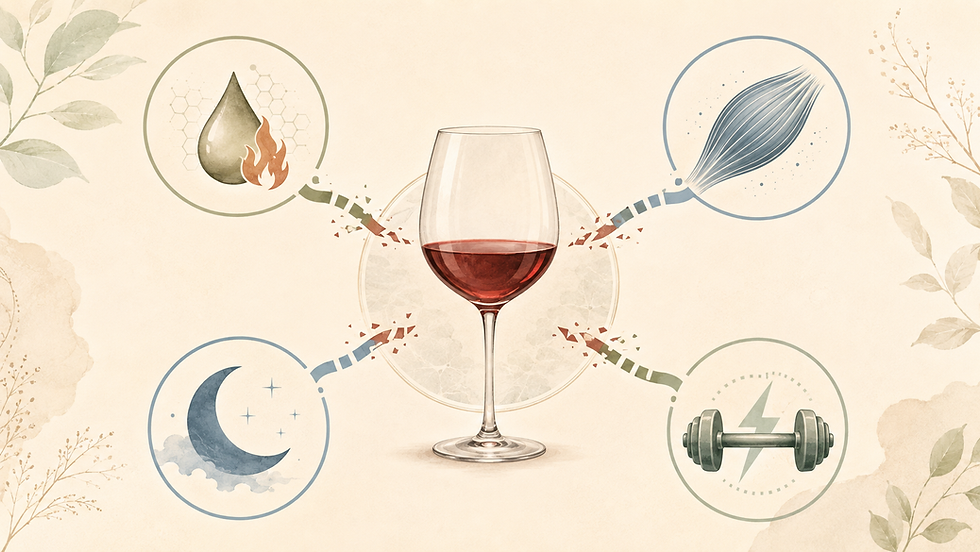
WHAT IS IN YOUR GLASS?
ALCOHOL IS NOT NEUTRAL
If your goal is to lose body fat, build muscle, or become stronger, we cannot skirt around the truth:
Alcohol directly works against the processes required to achieve those goals.
Alcohol provides approximately seven calories per gram, but the calories are only part of the story. Because your body cannot store alcohol, it prioritizes metabolizing and eliminating it.
During that process, fat oxidation—the use of fat for energy—temporarily decreases. This does not mean one drink immediately becomes body fat, but it does mean fat burning is placed on the back burner while alcohol is being processed.
Alcohol can also interfere with muscle repair. Strength training stimulates muscle protein synthesis, the process through which your body repairs and builds muscle. In a controlled human study, a large post-exercise dose of alcohol reduced muscle protein synthesis by approximately 24% even when participants consumed protein—and by approximately 37% when alcohol was consumed with carbohydrate instead. Those findings involved a heavy dose, so they should not be interpreted as the effect of one occasional drink.
They do, however, demonstrate something important:
Alcohol is not compatible with optimal muscle recovery.
Regular or excessive drinking can also make fat loss more difficult by adding calories that generally do not replace food calories, lowering inhibition, increasing food intake, disrupting restorative sleep, reducing next-day energy, and compromising training quality. A generous home pour or mixed drink may also contain considerably more than one standard serving.
You may still lose weight while drinking if you maintain an overall calorie deficit. But alcohol does not help the process—and the more frequently or heavily you drink, the more likely it is to interfere with the behaviors and physiology that support your results.
You cannot repeatedly compromise your sleep, recovery, training, food choices, and muscle-building response and then expect your body to perform as though alcohol were not present.
This is not shame. It is science.
If building muscle and losing body fat are genuine priorities, reducing or eliminating alcohol may be one of the most powerful changes you can make.
You work too hard for alcohol to keep quietly taking something back.
SUGAR CAN QUIETLY ADD UP TOO
Sugar is not poison.
Fruit is not the enemy.
A birthday cake is not a moral failure.
Added sugar, however, can become a problem when it appears in drink after drink, snack after snack, and meal after meal.
A 12-ounce regular soda may contain approximately 40 grams—or about 10 teaspoons—of added sugar.
Ten teaspoons!
And because liquid calories may not provide the same satisfaction as a balanced meal, they can be very easy to consume without noticing their impact.
The issue is rarely one cookie.
It may be the sweetened coffee, afternoon candy, flavored drink, evening dessert, sauces, and unmeasured bites that have become so routine they no longer feel like choices.
You do not need to fear every enjoyable food.
You do need to look at the pattern honestly.
EATING TOO LITTLE IS NOT THE ANSWER
Some people need to reduce their calorie intake to lose excess body fat.
Reducing calories and chronically underfeeding yourself are not the same thing.
Eating as little as possible is not automatically more effective.
When you do not consume enough energy and protein, weight loss may include both stored fat and valuable muscle.
You may also experience:
Fatigue
Weakness
Poor workouts
Slow recovery
Constipation
Feeling cold
Food preoccupation
Sleep disruption
Hair shedding
Loss of strength
Strong evening hunger
Severe restriction may also create a very predictable cycle:
Restrict. Become depleted. Overeat. Feel guilty. Restrict again.
That is not always a lack of discipline.
Sometimes, it is your body responding to a plan that was never sustainable.
Your metabolism does not magically shut down, and eating too little does not create body fat from nothing.
Prolonged restriction can reduce your energy expenditure. You may move less without noticing, struggle to train effectively, recover poorly, and eventually find the plan impossible to maintain.
You do not need starvation.
You need strategy.
A supportive plan should allow you to nourish your body, preserve your muscles, think clearly, exercise, recover, sleep, and remain consistent.
If your plan requires you to feel miserable in order to follow it, how long do you honestly believe you will follow it?
And don't forget about recovery!

TAKE AN HONEST INVENTORY
Before blaming your age, metabolism, hormones, or genetics, collect information.
Not a judgmental standpoint from an information gathering viewpoint.
For one week, pay attention to and log
Your protein intake
Vegetables and fiber-rich foods
Water
Sugary beverages
Alcohol
Portions
Distracted eating
How hungry you are when you arrive at meals
Sleep
Steps and intentional movement
Resistance training
Weekend eating
You may remember your best choices more clearly than the skipped meals, drinks, bites, handfuls, oversized portions, and weekend changes.
That does not make you dishonest. It makes you human.
An honest record gives you a starting location.
Remember, you cannot map a successful route without knowing where you are beginning.
YOU DON’T NEED TO REPAIR EVERYTHING TODAY
Choose one action.
Not five.
Not ten.
One.
You might:
Add protein to breakfast
Prepare lunch before you become overly hungry
Include a vegetable with dinner
Replace one sugary beverage with water
Measure a food you regularly underestimate
Plan your weekend meals
Reduce your alcoholic drinks
Eat one meal without your phone
Complete two resistance-training sessions this week
Small actions become powerful when you repeat them.
Your body does not need another dramatic change. It needs a program that works.
It needs evidence that your choices are becoming a pattern.
CONSISTENCY DOES NOT MEAN PERFECTION
Perfection says:
“I ate something that wasn’t planned, so today is ruined.”
Consistency says:
“That choice did not support my goal. My next choice still can.”
One choice does not erase your progress.
You do not need to punish yourself. Punishment will not allow growth.
You do not need to skip your next meal, instead plan a healthier one.
You do not need to wait until Monday, start with your next choice.
It's always one choice at a time.
Every meal is another opportunity to care for the body carrying you through this life.
Your body is not the problem.
It is listening, it's being programmed, it's following your protocol.
It is learning.
It is responding to what you do most often.
You do not need perfect nutrition.
You need enough protein, enough nourishment, and enough consistency for your body to stabilize and reach the goals you desire.
THIS WEEK
Before each meal, pause and ask:
Where is my protein?
Will this choice support how I want to feel later?
Then make one choice that reflects the life you say you want.
Not because you hate your stomach.
Because your body has been working for you all along—and it deserves to be supported.
Remember to love yourself today!
If you'd like a plan built specifically for you check out my virtual training offer.

Melissa Welfel BCS, CES, CNC, CPT, CWC, VCS
Specializing in Behavior Change, Wellness Coaching, Senior Fitness, and Metabolic Makeover
Growth sometimes means walking through fire—just remember, you don’t have to do it alone.
SCIENCE BEHIND THIS NEWSLETTER
Abdominal exercise and abdominal fat: Journal of Strength and Conditioning Research
Protein intake and resistance-training outcomes: British Journal of Sports Medicine
Protein and healthy aging: PROT-AGE Study Group
Added-sugar recommendations: Dietary Guidelines for Americans
Alcohol, serving sizes, and calories: National Institute on Alcohol Abuse and Alcoholism
Alcohol ingestion impairs post-exercise muscle protein synthesis


Comments